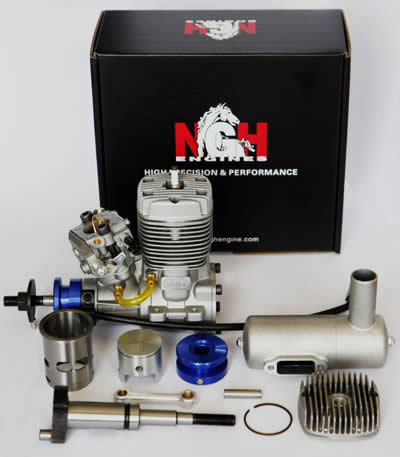
GT-17 Gas Engine Break in Procedure
The NGH GT17 gas engine is designed and manufactured using new precision sleeve cylinder technology. This technology has some parallels to glow engine technology and as such the break in process is different than other gas model engines using the older cast head and plated cylinder. A lengthy break in period is not necessary; however it is beneficial to follow the bench break in process below:
1. All NGH engines are tested before shipment, lubricated, and packed well for shipment.
2. Prop size is not critical but 13 X 8, 14 X 8, or 15 X 8 are recommended.
3. For break in use a high quality premix 100% synthetic oil for air cooled engines at a ratio of 25:1, i.e. 5.1 oz of oil per gallon of gasoline.
4. Break in RPM is 3000-4000 RPM
5. Break in time is about 1 hour, or between ¼ and ½ gallon of fuel.
6. Break in is best performed without a using a muffler, however if noise is an issue you can use the stock muffler.
After 1 hour of break in running time:
1. Check the idle speed, transition from low to high speed and high speed needle adjustment. Adjust the carburetor needle settings as required but only in very small changes. Normal settings are 1.5 turns out from fully closed for both the “L” and “H” needles.
2. Allow the engine to cool completely.
3. After cooling, open the back cover and add 10 drops of the synthetic oil (undiluted). Manually rotate the engine to lubricate all the parts, and allow excess oil to drain. Reinstall the back cover.
Install the engine into the model plane. Select the desired propeller; 13 X 8 for speed or 15 X 8 for torque according to the model requirements.
1) Oil mix ratio for flying is 30:1, i.e. 4.3 oz oil per gallon of gasoline if using a high quality synthetic.
2) The engine may be mounted in any position. Most common position is cylinder head down.
3) Restart the engine. Check the needle adjustments again. Be careful not to lean out the needle adjustments or the engine will be damaged.
4) Please note that the NGH GT17 gas engine uses a special Walbro carburetor WT962 (special made in Walbro factory, just for GT17), to optimize the performance of the GT17.
5.) After flying, clean and lubricate the engine. Remove the spark plug. Drop in a few drops of synthetic oil into the cylinder head and into the carburetor. Rotate the engine by hand.
6.) At the end of flying season the engine should be removed from the airplane, cleaned and well lubricated, then stored in a plastic bag.
7.) Your NGH GT17 is a precision machine so proper maintenance and care will ensure long engine life.
8.) Always check for loose fasteners on preflight checks after each flight.
Since NGH engines use a precision machined cylinder liner, the liner itself can be replaced if needed which is a distinct advantage over engines that do not use this technology saving time and money.
Specification :
Engine Type: Gasoline Two-stroke, Air Cooled, Rotary Valve
Cylinder Type: Precision Steel Sleeve
Cylinders: Single
Crank Type-Forged? Dual Ball Bearing Support
Mounting Type: Beam or Rail Mount
Carburetor Type : Walbro WT Series
Carburetor Mounting: Front
Crankshaft Threads: 5/16" X 24 TPI
Mounting Dimensions: Owners Manual or Website
Plug Type: 1/4 X 32
Displacement: 1.02 cu in.(16.91cc)
Bore: 1.14 in. (29mm)
Stroke: 1.01 in (25.6mm)
Engine (Only) Weight: 730g
Ignition Weight: 120g
Prop Range: 14*8,15*8,16*8
RPM Range:L 2100-9000
Fuel? Unleaded Gasoline With High-Quality 100% Synthese Oil, Pre- Mixed
compression ratio: 10
Pre-Mix Oil Ratio and Type ? Break-in with 25:1, General 30:1, For Air Cooled Engines