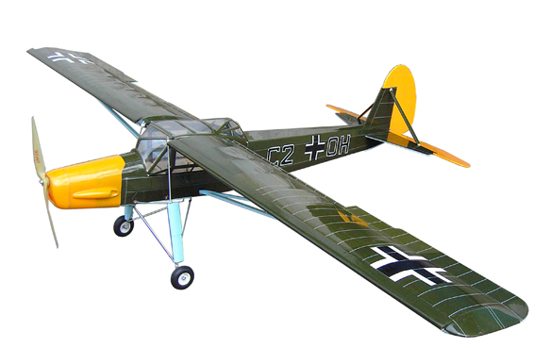
The Fieseler Fi 156 Storch (stork) was a small German liaison aircraft built by Fieseler before and during World War II, and production continued in other countries into the 1950s for the private market. It remains famous to this day for its excellent STOL performance, and French-built later variants are a common fixture at air shows.
In 1935, the RLM (Reichsluftfahrtministerium, Reich Aviation Ministry) put out a tender for a new Luftwaffe aircraft (suitable for liaison, army co-operation today called Forward Air Control), and medical evacuation, as required to several companies. Penned by chief designer Reinhold Mews and technical director Erich Bachen, Fieseler's entry was the most advanced in terms of STOL performance, by far. A fixed slat ran along the entire leading edge of the long wings, while the trailing edge, inspired by earlier 1930s Junkers aircraft wing control surface designs, including the ailerons, was a hinged and slotted flap. The wings could be folded back along the fuselage, allowing it to be carried on a trailer or even towed slowly behind a vehicle. The long legs of the landing gear contained oil and spring shock absorbers that compressed about 450 mm (18 inches) on landing, allowing the plane to set down almost anywhere. In flight they hung down, giving the aircraft the appearance of a very long-legged, big-winged bird, hence its nickname, Storch. With its very low landing speed the Storch often landed "at place" or even backwards, in case of wind from directly ahead.
The Fieseler Fi 156 Storch is known for short take off and landing (STOL) abilities. In a slight breeze, it can take off in about 200 feet and land in about 70 feet.
Although the Fieseler Fi 156 Storch served in virtually every theatre occupied by the German army, it may best remembered as the plane used in the rescue of Benito Mussolini in the Gran Sasso Mountain range on September 12, 1943.
Pilots report the Fieseler Fi 156 Storch as a pleasant aircraft to fly. Cockpit visibility is excellent. The rear folding wings make storage possible in small spaces. Aileron response is positive with only a light touch needed. There is a wheel on the left side of the cockpit that controls the flaps. It takes of bit of strength to deploy the flaps in their full 70 degrees of range. However, for take off, generally 20 to 40 degrees is used. Starting the engine of the aircraft is a breeze, no matter the weather.
Variants of the Fieseler Fi 156 Storch were produced in France and Czechoslovakia through 1950.
Over 2,900 Fieseler Fi 156 Storch aircraft of all types were produced. Some twenty are still flying today, and are often seen at air shows.
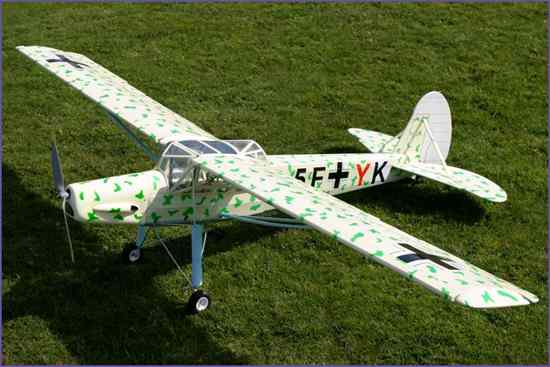
The VMAR Fiesler FI-156 Storch is a highly detailed semi scale model of this famous aircraft. Traditionally constructed of laser cut balsa and ply the model is covered in VMAR’s Polycote covering. The model is full of scale details including the huge glazed cabin, large sprung undercarriage and working flaps that actuate in a scale like manner. This model is an excellent reproduction of this unusual subject.
This kit comes in ARF versions, everything you need for ready to fly must be purchased seperately